
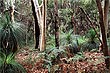
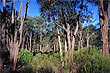
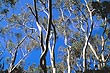
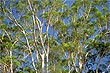
Eucalyptus - photos
 |  |  |  |
 |  |  |  |
 |  |  |  |
 |  |  |  |
Related Photo Galleries | |||
 |  |  |  |
About Eucalyptus
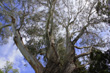
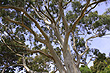
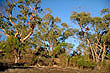
Eucalyptus is a diverse genus of trees (rarely shrubs), the members of which dominate the tree flora of Australia. There are more than 700 species of Eucalyptus, mostly native to Australia, with a very small number found in adjacent parts of New Guinea and Indonesia. Eucalypts can be found in almost every part of the continent, adapted to all of Australia's climatic conditions; in fact, no other continent is so characterised by a single genus of tree as Australia is by eucalyptus. Many, but far from all, are known as gum trees; other names for various species include mallee, box, ironbark, stringybark, and ash.
The most readily recognisable characteristics of Eucalyptus species are the distinctive flowers and fruits. The name Eucalyptus means 'well-covered' it describes the bud cap (technically called an operculum). This cap forms from modified petals and falls off as the flower opens. Thus flowers have no petals, decorating themselves instead with many showy stamens. The woody fruits are roughly cone-shaped and have valves at the end which open to release the seeds.
Nearly all eucalypts are evergreen, but some tropical species lose their leaves at the end of the dry season. As in other members of the Myrtle family, eucalypt leaves are covered with oil glands. The copious oils produced are an important feature of the genus. Eucalypts also exhibit leaf dimorphism. When young, their leaves are opposite and often roundish and occasionally without petiole. When several years old, the leaves become alternate, quite slender and with long petioles. Plants do not flower until adult foliage starts to appear, except in E. cinerea.
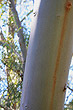
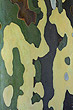
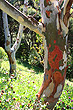
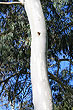
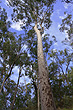
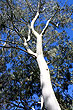
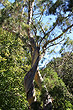
The bark dies annually and species can be roughly grouped based on its appearance. In smooth-barked trees most of the bark is shed, leaving a smooth surface that is often colourfully mottled. With rough-barked trees the dead bark persists on the tree and dries out. Many trees, however, have smooth bark at the top but rough bark on the trunk or its bottom. The types of rough bark is often used to broadly label a group of eucalypts. They are:
- Stringybark - consists of long-fibres and can be pulled off in long pieces. It is usually thick with a spongy texture.
- Ironbark - is hard, rough and deeply furrowed. It is soaked with dried kino (a sap exuded by the tree) which gives a dark red or even black colour.
- Tessellated - bark is broken up into many distinct flakes. They are corkish and can flake off.
- Box - has short fibres. Some also show tessellation.
- Ribbon - this has the bark coming off in long thin pieces but still loosely attached in some places. They can be long ribbons, firmer strips or twisted curls.
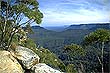
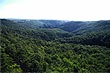
On warm days vapourised eucalyptus oil rises above the bush to create the characteristic distant blue haze of the Australian landscape. Eucalyptus oil is highly flammable (trees have been known to explode) and bush fires can travel easily through the oil-rich air of the tree crowns. The dead bark and fallen branches are also flammable. Eucalypts are well adapted for periodic fires, in fact most species are dependent on them for spread and regeneration, both from reserve buds under the bark, and from fire-germinated seeds sprouting in the ashes.
Author & photographer: David Johnson (Virtual Australia). Providing a credit or link is appreciated.
Our content: logos, site names, text, photos, and website design are protected by international copyright law.
Original versions of our photos can be purchased / licensed & web versions can be shared subject to conditions.