
Moriori Culture
While many are aware that the native people of New Zealand are the Maori, there also existed another native group called the Moriori.
The Moriori inhabited the Chatham Islands of New Zealand which lie east of the main islands. Linguistic evidence suggests that they originally inhabited the main islands of New Zealand and migrated to the Chathams. Their native language has common words with the Ngāi Tahu Maori tribe of the South Island. Today, there are no full-blooded Moriori left, but some still have Moriori ancestry.
The Moriori were dedicated to living lives of non-violence and passive resistance. As commendable as this was, it was their undoing as they lacked protection from the warrior culture of the Maori who were highly skilled in warfare. Besides this difference and despite both cultures being Polynesian, the Moriori did not adorn their bodies and faces with tattoos like the Maori.
It is believed that the Moriori came to the Chatham Islands some time before 1500 AD. It is also feasible that prevailing South Pacific wind patterns enabled them to reach the Chatham Islands from the South Island during the period of Polynesian colonisation of New Zealand.
The Chathams are isolated from the main islands of New Zealand and are on average colder and more exposed to the weather. This meant that many crops that grew in New Zealand and the South Pacific were not able to be cultivated here and as a consequence, the Moriori lived as hunters and gatherers where food was almost entirely taken from the sea. This included fish, seals, and sea birds. Due to the size of the Chatham Islands, they supported only a small population of about 2000 people.
The Moriori's pacifist culture of substituting warfare for ritual fighting led to reconciliation rather than harm or death. This code of conduct was attributed to Nunuku-whenua their ancestor .
"...because men get angry and during such anger feel the will to strike, that so they may, but only with a rod the thickness of a thumb, and one stretch of the arms length, and thrash away, but that on an abrasion of the hide, or first sign of blood, all should consider honour satisfied"
Unlike what happened on Easter Island with habitat destruction and the decline of the native people, the Moriori lived with care due to limited resources. This ideal and peaceful lifestyle came to a sad end when they were invaded by Maori. On the 19th of November 1835, a European ship arrived in the Chathams carrying 500 Maori who were armed with guns, axes, and clubs. Another ship followed with 400 more Maori on the 5th of December 1835. They proceeded to kill and enslave Moriori and even cannibalism was practiced. Maori warriors penetrated Moriori tribal settlements with ease and without warning. They were informed by the invading Maori that the inhabitants land now belonged to Maori.
According to survivors, some Moriori elders and chiefs wanted to fight for their land and their lives, but two chiefs, Tapata and Torea declared that "the law of Nunuku was not a strategy for survival, to be varied as conditions changed; it was a moral imperative." Unfortunately, their passive resistence led to their genocide.
"[The Maori] commenced to kill us like sheep.... [We] were terrified, fled to the bush, concealed ourselves in holes underground, and in any place to escape our enemies. It was of no avail; we were discovered and killed - men, women and children indiscriminately." A Maori conqueror explained, "We took possession... in accordance with our customs and we caught all the people. Not one escaped....."
After the invasion, Moriori could not marry or to have children among themselves. Survivors became slaves of the Maori and many Moriori died from despair. Many Moriori women had children by Maori with a small number of women eventually marrying Maori or Europeans. In 1863 only 101 Moriori were left from a population of around 2,000. Today, there are several thousand people with some Moriori ancestry. In 1933. Tommy Solomon, the last full-blooded Moriori died.
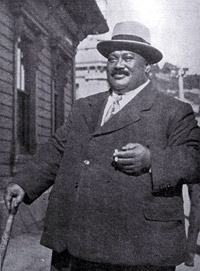 | Photo of Tame Horomona Rehe (aka Tommy Solomon) the last surviving full-blooded Moriori. Location: Christchurch on the South Island Tame Horomona Rehe was born at the Chatham Islands in 1884. He was raised on a Moriori Reserve at Manukau, Auckland in the North Island and died of pneumonia and heart failure in 1933. A statue was eventually erected at Manukau in 1986 as a memorial to him. File Reference: CCL PhotoCD 5, IMG0077: Christchurch City Libraries. |
Moriori are enjoying a renaissance to some degree and have been recognised as original inhabitants of the Chatham Islands. In Te Papa, the national museum of New Zealand, there is a display area dedicated to their story. Some Moriori descendants have made claims under the Treaty of Waitangi which is usually thought of as being an exclusive covenant with the Crown and Maori.
Author & photographer: David Johnson (Virtual New Zealand). Providing a credit or link is appreciated.
Our content: logos, site names, text, photos, and website design are protected by international copyright law.
Original versions of our photos can be purchased / licensed & web versions can be shared subject to conditions.